Fighting Isolation — How to Foster Human Connections.

     Here’s a summary of an outstanding recent piece on how to foster human connections. We all know now that there is a public health crisis concerning isolationism, caused primarily by the new technology and social media.

………………………………………………

Key points …..

  • People are more interested in engaging with you than you might imagine.
  • Connection is built on reciprocity.
  • Focus on the frequency rather than intensity of positive interactions. six insights on connection ………………….
  1. People are more interested in engaging with you than you might imagine.

We tend to be overly pessimistic about how positively others will respond when we reach out to them. According to Epley, this stems largely from misunderstanding other people and is particularly acute with strangers. Whenever a belief keeps us from acting, we miss out on the data from experience that could confirm or disprove it. “If we’re even a little nervous about how others will respond, we won’t reach out, and so we never learn that the belief is mistaken,” he explains.

Here’s more good news. It may be true that others aren’t paying nearly as much attention to us as we imagine (the spotlight effect). But it’s often because they are focused on other things (mostly themselves)—not because they don’t care about us. When others are paying attention to us, they usually don’t judge us as negatively as we fear. In fact, people often underestimate how much others will like them after a conversation (the liking gap).

  1. Connection is built on reciprocity.

Don’t underestimate the power of reciprocity. A social interaction is an exchange with dynamic features, explains Epley. It goes back and forth. In fact, what makes social interaction a positive experience is the interaction itself. “In conversation, people like you not just for what you say, but for what you do—your facial expressions, nodding, smiling, showing you understand,” he says. These paralinguistic cues create affirmation, responsiveness, and, ultimately, connection.

It’s not just connecting that matters, but how we connect. “Dialogue—with its reciprocity and responsiveness—is what people underestimate. They imagine monologues, but what they actually experience is a dynamic exchange that feels much better than expected.”

  1. Focus on the frequency rather than the intensity of positive interactions.

“It’s the frequency of positive emotions, rather than their intensity, that determines our well-being,” says Epley. Even little social interactions—a smile, a compliment, a kind act—can nurture happiness. A good marriage, for example, fosters sustainable well-being because it provides many small positive moments every day.

Happiness is often compared to a leaky tire: something good happens and the tire fills up. Then it slowly drains down. That doesn’t mean you live life on a flat tire, says Epley. It means you keep pumping it up. “Treat sociality like a habit, something you do routinely. Whenever you have the chance, sprinkle it in.”

  1. Imagine connection as the physical distance between you and others.

When considering how connected you feel to someone, ask yourself: How close do they feel to me in physical space? Researchers sometimes represent the concept of connection as the “inclusion of the other in the self.” To illustrate this, they use two circles that can be far apart, close together, or even overlapping, depending on the level of connection. Spouses, for example, may feel so integrated that they forget where one ends and the other begins, and use the word “we” more than “I”. Even strangers, Epley explains, can feel either very distant or very close.

  1. Your personality matters… more for your expectations than your actual experience.

Personality traits are more strongly related to people’s expectations, habits and choices than to their actual experiences in interactions, says Epley. “Introverts believe they will feel more tired or enjoy an interaction less than extroverts do. Yet, when they are actually in the interaction, they either underestimate how much they’ll enjoy it like the extroverts do, or sometimes even more. Often, what we think of as experiences are just our beliefs and expectations.”

  1. Your beliefs can become your barriers.

Epley’s research shows that when asked to imagine talking to a stranger on a train, people predict they’ll enjoy it more than keeping to themselves. Yet, the barrier that prevents them from trying is the belief that others don’t want to engage. “We misjudge others. We assume there are more people who will reject us than there actually are,” says Epley. Moreover, while people expect social rejection to sting more than connecting will please them, Epley argues that it’s often more their expectation not the actual experience. “Negative emotions (whether from social or non-social pain) often fade faster than positive ones, thanks to our psychological immune system that helps us rationalize failures and move on.”

A Final Tip ……………

There’s no magic set of opening lines for starting the most connection-fostering conversations.

The secret lies in a mindset: taking a genuine interest in others and paying attention.

The How of Human Connection.” Psychology Today (February 2026).

ChatGPT and Intimacy — Risks & Self-Regulation.

     ChatGPT will create and engage in erotic content starting December 2025. Using AI to deliver sexual content is not exactly new.

     So, as AI platforms double down on erotic content, how do we overcome our moral panic and work towards safer and more thoughtful integration of AI into our personal lives? Here are some points to consider: Sex sells, but intimacy drives revenue; effective age verification is an illusion; the mental health issues are far from resolved; online sexual crimes will increase exponentially; men and boys are targets.

     How to Engage — Practice ruthless self-regulation and understand risk!

                “Ai is Putting “X” in Xmas.” Psychology Today (Nov. 2025).

Retirement and How to Adjust & to Thrive.


     Retirement carries a risk of what sociologists call social death. Social death is not inevitable. Remaining socially engaged is the key to flourishing in retirement. Social death can be turned into social rebirth, setting the occasion for a meaningful retirement.


     Here are some steps that can be taken:


     Actively seek out new social relationships. Find ways to remain involved in your profession. Remain intellectually engaged. Maintain or increase your physical activity. Exercise helps maintain brain health. Moreover, many forms of exercise include social interactions. Be grateful for the past and optimistic for the future.


See for more information“Retirement and Relationships.” Psychology Today (2025).

Ai and Relationships — Future is Unclear.

“Nations all over the world are dumping millions and billions into AI research and patenting. The news is saturated with new GPT version releases, people being manipulated by or falling in love with AI agents …. But recently, I’ve noticed myself pushing back on the torrent of technology infiltrating our lives in both morally questionable and downright annoying ways. Educators, writers, policymakers, and podcast hosts have all begun to acknowledge that it’s somewhat disconcerting to be living in the wild West of AI, where everyone’s using it and no one’s regulating it. Of course, that’s an overstatement, but it is a fact that AI rolled out lightning quickly before anyone had time to consider its moral implications and how it should be regulated for the safety of humankind.” “Ai Fatigue and Breaking Away from it.” Psychology Today (Sept. 2025).

Teenagers, Young Couples and Chatbot Digital Therapy — Dangerous? — Yes.

” Marketed as conversational agents, chatbots are becoming de facto digital therapists for many teenagers and young couples, for whom this technology now feels native. This raises the stakes for ensuring these tools are safe and governed by enforceable standardsNearly half of young Americans ages 18 to 25 with mental health needs received no treatment last year — a gap that makes the appeal of 24/7, judgment-free companionship even stronger …. Some states are beginning to act. Illinois just passed a law barring licensed mental health professionals from using A.I. in therapeutic decision-making. But most teenager-chatbot interactions happen outside clinical settings, and they involve conversations about emotional and social well-being rather than about formal medical treatments.” “Chatbot Therapy for Teenagers —  Dangerous.” New York Times (August 27, 2025).

PSYCHOLOGY TODAY — Sandy Malawer, LPC, LMFT — Family Therapy Center of McLean (Since 1986).


703.893.9063. 703.346.7065 (cell).  SandyMalawer@msn.com
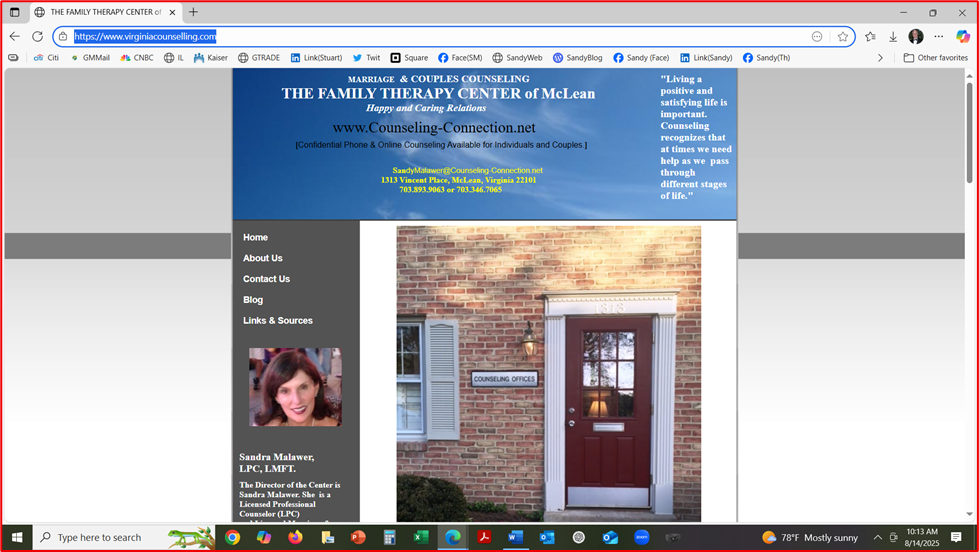
https://www.virginiacounselling.com/
 
THE FAMILY THERAPY CENTER specializes in all aspects of individual,  couples and marriage counseling. In particular, we focus on fostering better communications, cross-cultural counseling, and on a “relationship-focused therapy.” We view counseling as a way to assist clients in defining their critical concerns, identifying their strengths, and achieving their goalsSolutions are developed by formulating specific actions — coaching you to achieve your true potential. Counseling is a positive action that empowers people. Allowing clients to gain control of their lives.
 
We specialize in all aspects of individual, marriage and family counseling including military and intelligence families, premarital, couples and individual counseling that often involves cross-cultural issues and developing better communication skills. Counseling is in a comfortable and confidential setting. Often individual counseling can lead to couples and family counseling.     
 
 
The Family Therapy Center was established in 1986 in McLean, Virginia, as the Professional Counseling Center of McLean. The Center is located in central Mclean, Virginia, at 1313 Vincent Place, McLean, Virginia 22101. PHONE COUNSELING and ONLINE (Zoom) available. 703.893.9063. 703.346.7065 (cell).  SandyMalawer@Counseling-Connection.net
 
S                                          1313 Vincent Place, McLean, Virginia                                                            .
Couples as Friends — Even More Important Today.

     One of the issues confronting couples today is the relationship and friendship with other couples — especially as social isolation has become a plague in our social media era. A decade or so ago Psychology Today presented an article discussing what makes for couple’s friendship. Such friendship reinforces the couple’s own relationship. Needless to say, social media has made this issue even more complex today. The following is from that article …………..


“One of the biggest challenges for couples is to determine how to spend their time – do they spend it alone with just each other, alone without their partner, each partner with individual friends, with family, or with other couples? ….  It is well-established that people with friends live longer, healthier, and happier lives. Friends keep us on our toes, socially engaged, and mentally active …. Couples who share friends (which include individuals or family members) tend to be happier. These couples get to be together with friends and family and engage in enjoyable and meaningful activities. They are more fully integrated into their social network if friendships are shared and this may re-enforce their own relationship …. Related to marital/partner happiness, couple friendships can strengthen individual friendships that the couple has with one or both members of the other couple. Many couples described friendships that began on a one-to-one basis; the men knew each other from college or the women met at work and then introduced their spouses to each other. The opportunity to still go out alone with the close friend as well as with the other partners of the friends re-enforces the earlier friendship. “Couples Friendly with other Couples.” Psychology Today (2012).

Is Lack of Sex a Ground for Divorce?

“A French court had ruled that a woman had violated her marital duties by not having sex with her husband. The European Court of Human Rights condemned that decision. Europe’s top human rights court said that the French court’s decision had violated the woman’s right to private life and autonomy, which included her sexual life. The decision was seen as a milestone by women’s rights activists who have long raised concerns about France’s marital laws …. It was a symbolic victory for the woman, who had argued that she should not have been found at fault in the divorce. Women’s rights groups called the decision a fundamental step to address sexual violence and other forms of abuse against women in relationships.” “European Court – Wife Entitled to Refuse Sex.” New York Times (Jan. 26, 2025).

Loneliness — It’s an Epidemic — Why is it Increasing?

“What do the loneliness epidemic, falling rates of adolescent drinking and dating, and worsening mental health among teenagers and young adults have in common? …. Trends in time spent alone are an almost exact parallel of trends in mental health, where rates of mental distress are mounting among the young, but not the middle-aged or older …. The most obvious culprit in terms of timing and age gradient is the proliferation of smartphones and hyper-engaging social media, which has kicked into overdrive with the era of short-form video …. The last decade is a story of young people retreating from the pursuits that bring them the most fulfilment, and replacing them — consciously or otherwise — with pale imitations. “Young People are Hanging out Less – Unhealthy for Mental Health.” Financial Tines (January 17, 2025).