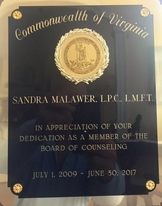
PSYCHOLOGY TODAY — Sandy Malawer, LPC, LMFT — Family Therapy Center of McLean (Since 1986).


703.893.9063. 703.346.7065 (cell).  SandyMalawer@msn.com
https://www.virginiacounselling.com/
 
THE FAMILY THERAPY CENTER specializes in all aspects of individual,  couples and marriage counseling. In particular, we focus on fostering better communications, cross-cultural counseling, and on a “relationship-focused therapy.” We view counseling as a way to assist clients in defining their critical concerns, identifying their strengths, and achieving their goalsSolutions are developed by formulating specific actions — coaching you to achieve your true potential. Counseling is a positive action that empowers people. Allowing clients to gain control of their lives.
 
We specialize in all aspects of individual, marriage and family counseling including military and intelligence families, premarital, couples and individual counseling that often involves cross-cultural issues and developing better communication skills. Counseling is in a comfortable and confidential setting. Often individual counseling can lead to couples and family counseling.     
 
 
The Family Therapy Center was established in 1986 in McLean, Virginia, as the Professional Counseling Center of McLean. The Center is located in central Mclean, Virginia, at 1313 Vincent Place, McLean, Virginia 22101. PHONE COUNSELING and ONLINE (Zoom) available. 703.893.9063. 703.346.7065 (cell).  SandyMalawer@Counseling-Connection.net
 
S                                          1313 Vincent Place, McLean, Virginia                                                            .

Couples as Friends — Even More Important Today.

     One of the issues confronting couples today is the relationship and friendship with other couples — especially as social isolation has become a plague in our social media era. A decade or so ago Psychology Today presented an article discussing what makes for couple’s friendship. Such friendship reinforces the couple’s own relationship. Needless to say, social media has made this issue even more complex today. The following is from that article …………..


“One of the biggest challenges for couples is to determine how to spend their time – do they spend it alone with just each other, alone without their partner, each partner with individual friends, with family, or with other couples? ….  It is well-established that people with friends live longer, healthier, and happier lives. Friends keep us on our toes, socially engaged, and mentally active …. Couples who share friends (which include individuals or family members) tend to be happier. These couples get to be together with friends and family and engage in enjoyable and meaningful activities. They are more fully integrated into their social network if friendships are shared and this may re-enforce their own relationship …. Related to marital/partner happiness, couple friendships can strengthen individual friendships that the couple has with one or both members of the other couple. Many couples described friendships that began on a one-to-one basis; the men knew each other from college or the women met at work and then introduced their spouses to each other. The opportunity to still go out alone with the close friend as well as with the other partners of the friends re-enforces the earlier friendship. “Couples Friendly with other Couples.” Psychology Today (2012).

Is Lack of Sex a Ground for Divorce?

“A French court had ruled that a woman had violated her marital duties by not having sex with her husband. The European Court of Human Rights condemned that decision. Europe’s top human rights court said that the French court’s decision had violated the woman’s right to private life and autonomy, which included her sexual life. The decision was seen as a milestone by women’s rights activists who have long raised concerns about France’s marital laws …. It was a symbolic victory for the woman, who had argued that she should not have been found at fault in the divorce. Women’s rights groups called the decision a fundamental step to address sexual violence and other forms of abuse against women in relationships.” “European Court – Wife Entitled to Refuse Sex.” New York Times (Jan. 26, 2025).

Loneliness — It’s an Epidemic — Why is it Increasing?

“What do the loneliness epidemic, falling rates of adolescent drinking and dating, and worsening mental health among teenagers and young adults have in common? …. Trends in time spent alone are an almost exact parallel of trends in mental health, where rates of mental distress are mounting among the young, but not the middle-aged or older …. The most obvious culprit in terms of timing and age gradient is the proliferation of smartphones and hyper-engaging social media, which has kicked into overdrive with the era of short-form video …. The last decade is a story of young people retreating from the pursuits that bring them the most fulfilment, and replacing them — consciously or otherwise — with pale imitations. “Young People are Hanging out Less – Unhealthy for Mental Health.” Financial Tines (January 17, 2025).


Decline of Coupledom and Rise of Singledom.

     The general demographic story today is the decline of couples and the rise of singledom worldwide. Many reasons for this. But research now points to the rise of social media and cell phones. This is often accompanied by loneliness and frustration. The bright spot is that people are beginning to realize this and starting to take corrective action.  Less social media and more personal interaction. However, many may prefer singledom.

“In recent years most of the fall in birthrate is coming not from the decisions made by couples, but from a marked fall in the number of couples …. The central demographic story of modern times is the rising rates of singledom: a much more fundamental shift in the nature of modern societies. Relationships are not just becoming less common, but increasingly fragile …. But the rise of singledom and relationship dissolution is a less rosy story …. But the wider data on loneliness and dating frustrations suggests not all is well. The trend is global …. Why an almost worldwide decline, and why now? The fact that this is happening almost everywhere all at once points more to broad changes acting across borders than country-specific factors. The proliferation of smartphones and social media has been one such exogenous ….  and boosts female empowerment …. The fall in coupling is deepest in extremely online Europe …. A world of rising singledom is not necessarily any better or worse than one filled with couples and families, but it is fundamentally different to what has come before, with major social, economic and political implications.” “Relationship Recession is Going Global.” Financial Times (January 11, 2025).

New Technology and Mental Health Treatment — Some Early Promise.

“There is an emerging frontier of mental health treatments using new technologies that are offering promising early results and possibilities. Motivated in part by the limitations of existing treatments — mostly involving drugs or talk therapy with a psychologist — many researchers are looking to develop digital tools to treat mental health …. Technology treatment may be in its infancy and will need to undergo rigorous and much bigger testing. But it illustrates how the next generation of therapies has the potential to be far more accessible and straight forward than before — with implications for the many people seeking help for mental health. You don’t need medication for that, you don’t need a psychologist to talk about your life  …. It’s so simple — just sitting in front of a computer.” ”Tech-Powered Treatments.” Financial Times (December 18, 2024).


Global Mental Health Pandemic — Young People, Couples & Social Media.

“A mental health pandemic is engulfing the world’s workplaces ….  The scale of the problem is hugely worrying, particularly among young people ….  Factors driving the global mental health crisis range from the cost of living to the pervasive use of social media …. However, after huge progress on improving mental health at work, some campaigners are warning of worrying signs of a reversal — partly as a result of a backlash against “woke” attitudes and a belief that such concerns even fuel mental health disorders. There’s more unhelpful rhetoric going around, with people using terms like ‘snowflake’ and beginning to point towards mental health as being a cause of inactivity in the economy This is leading to an increase in stigma which will prevent people speaking up about it. This is a challenge for us.” “Global Mental Health Crisis Among Young and in the Workplace.” Financial Times (Dec. 17, 2024).

Emotional Affairs — Not a Great Idea. But Can Tell You a Lot About Your Marriage.

     A good piece appeared today discussing emotional affairs and how prevalent they are in our online age. The bottom line — It’s not necessarily sexual but it’s infidelity. An emotional connection outside your marriage tells you a lot about your marriage.


“Are you texting and emailing with a friend, or is it a kind of an affair? It can be a slippery slope. You likely have close confidants. But when you find yourself sharing more with someone than you do with your partner, developing romantic feelings for that person, and keeping this intimacy a secret, you may be having an emotional affair. Anyone could be susceptible to an emotional affair, especially in our online age. Social media has both expanded our opportunities for connection and made it easier to hide them from others. An emotional affair doesn’t necessarily mean sexual attraction. A friendship can slide into emotional infidelity when you keep it a secret from your spouse and prioritize the relationship over your marriage. An emotional connection outside of your marriage can tell you about what’s missing in your relationship.”  “Emotional Affairs.” Wall Street Journal (Oct. 23, 2024).

Renewing Intimacy after Infidelity — Yes, It’s Possible!


     Renewing intimacy after infidelity is possible. It takes hard work but many couples have achieved this — Renewing intimacy (both emotional and physical) and a loving relationship occurs more often than many people think. The following is an excerpt from a very thoughtful article that appeared recently.


“Infidelity can be a devastating experience for both partners, leaving deep emotional wounds that need to heal. It’s hard work to rebuild trust and intimacy after the betrayal of infidelity, but when both partners are willing to do the work, it’s worth it. It is possible to move forward, find healing, and even rekindle the passion and connection you long for …. When you’re healing from broken trust, it can feel all-consuming. It is helpful to plan some weekly outings where talking about the infidelity and healing was off the table. To start having fun together again. All work and no fun stalls out the healing process.  A lot of work and some fun mixed in is key to working through the past and creating a new present and future together …. Put a regular date night on the calendar and then commit to not discussing “issues” on those dates …. As you grow emotional intimacy outside the bedroom, you begin healing inside the bedroom. There may be tears the first few times of physical intimacy. If that happens, slow things down and hold the hurting partner …. Infidelity can be a devastating experience, but it doesn’t have to be the end of the relationship. With hard work and dedication, it is possible to move forward and find incredible intimacy and connection in your marriage.” “Renewing Intimacy after Infidelity.” (March 2023).


Parent-Child Estrangement — Heartbreak.

A good article appeared recently discussing the heartbreak of parent-child estrangement. The bottom line is that this is a very difficult problem. However, a number of positive strategies are available to try to change the situation. Here’s an excerpt from this recent article ….

“While sometimes parents initiate estrangements, studies show that it’s more often their offspring who terminate the relationship. For the parent, there is no upside to an estrangement: It’s all shame, loss, regret and fear. However, estrangement from the adult child’s perspective offers an opportunity to demonstrate greater authority and autonomy in the relationship with the parent, set limits on hurtful behavior, express aspects of their individuality such as gender identity or sexuality, or enforce stronger boundaries …. Children can change dramatically over the course of their lives, but so can a parent. There will inevitably be aspects that the other finds challenging or difficult. In family, our task is to ensure that love and support remain the guiding principles; to find ways to communicate that foster closeness and reduce hurt; and to hope for patience — theirs and ours —­ as we navigate these new and uncharted territories of parent-adult child relationships.” “Parent-Child Estrangement.” Washington Post (August 20, 2024).